Alderstilpasset BokRobot-bok
Economic Sophisms for age 12
Economic Sophisms
Bastiat, Frédéric
For 12 år · 24 sider · 4 285 ord Engelsk
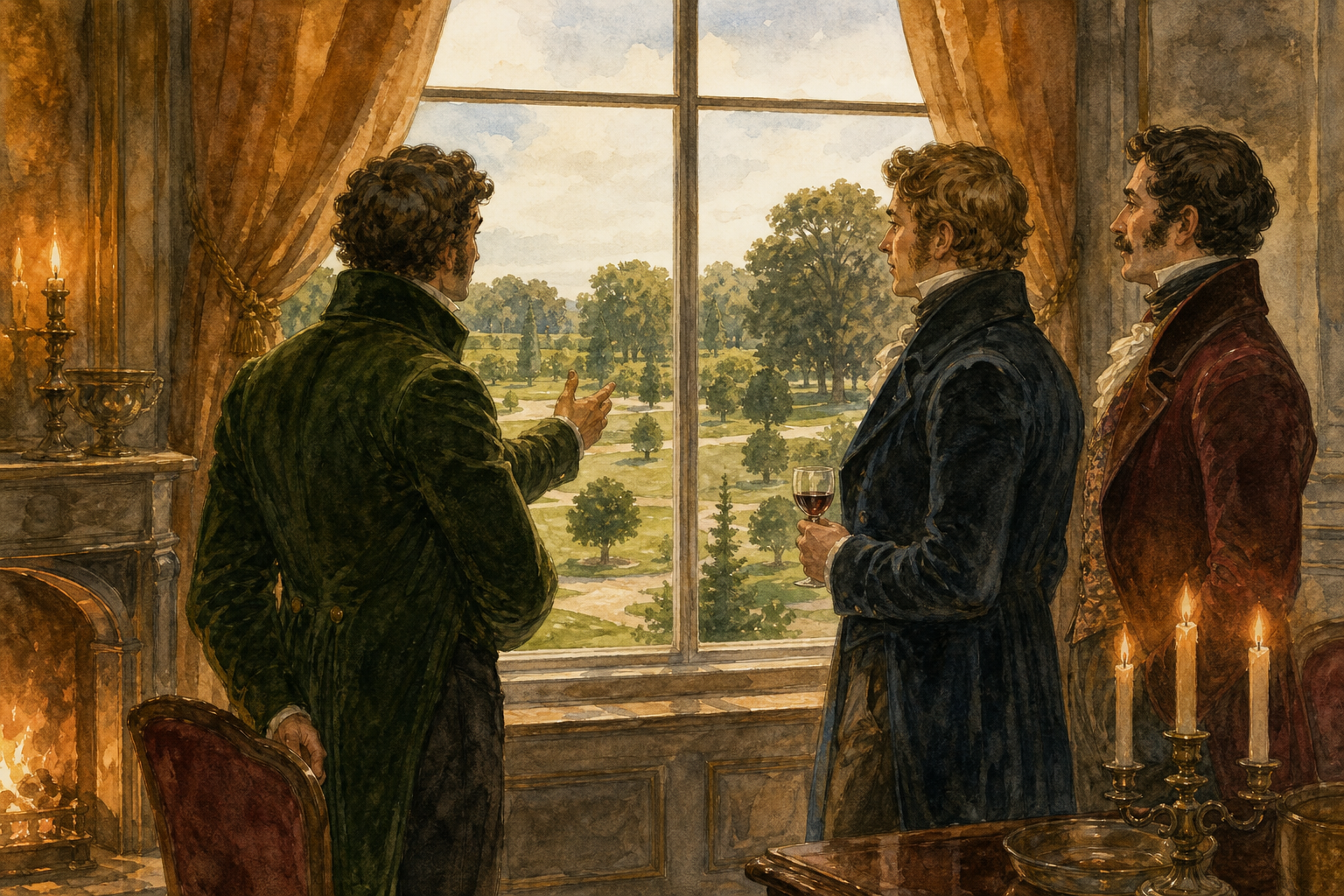
After dinner, in the warm glow of chandeliers and fireplaces, three men stood by a window in a grand townhouse overlooking a pretty park. Master Peter nodded contentedly at his trees. He had an idea that felt both caring and clever. He would open his own timber yards and sell firewood to the poor of Paris. Not as charity. He would do good – and make money. The plan was simple: get the city council to set a high toll on all wood floating down the rivers, so high that no wood from outside could get past the gates. Then the city would have to buy from him. No competitors, plenty of buyers. The poor, he said, would be warmed by his kindness – and his wood, which would be expensive but secure.
Paul suddenly felt his heart warm too. He said that Parisian butter always stuck in his throat because it came from Normandy and Brittany. He would build cow stables inside the city and give the poor milk and butter from Paris itself, if only the council would protect him from the flood from the countryside. High tolls on dairy, and he would sell at a price that showed his love for the people.
John, who had listened with growing admiration and a small pang of envy, did not want to be less merciful. He proposed that pigs, both alive and dead, from Poitou and all other provinces that spoiled Paris with cheap bacon, should be stopped. Then he would become the city's natural butcher for all things ham, bacon, and sausages.
A small quarrel arose. Each man's monopoly would make the others' raw materials more expensive. If wood became dear, butter would cost more. If butter became dear, sausages would become expensive. Their profits would eat each other. But then they found the old solution. They would stick together. They would talk about the people's good, not their own pockets. Paul would speak for Peter's wood. John for Paul's butter. Peter for John's bacon. Each would pretend to be as pure as snow, and praise the others' needs. Thus they would storm the city toll in the name of charity.
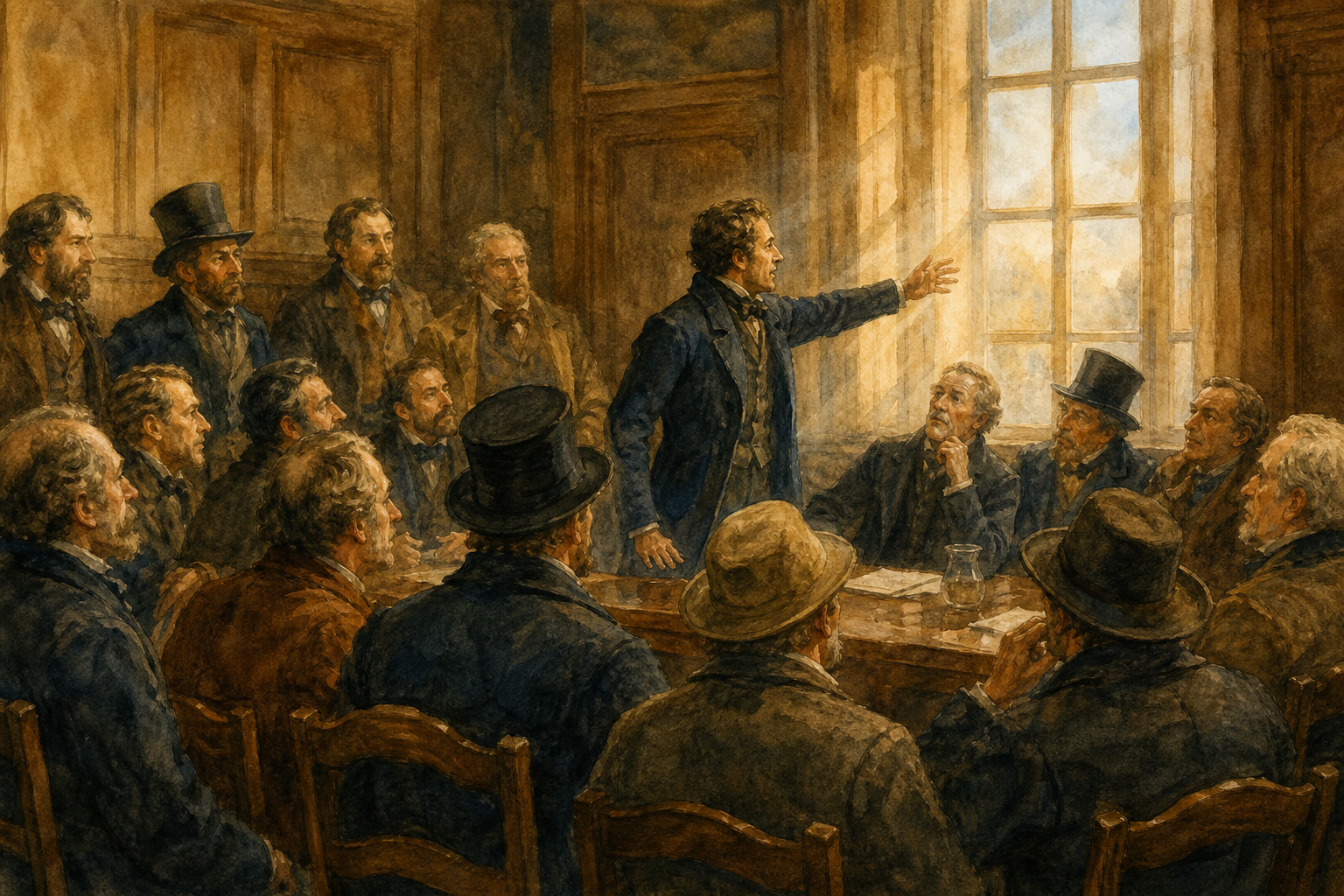
The council assembled. The room was full of hats, quills, and big words. Paul spoke first. Every log of outside timber, he said, was money flowing out of Paris like a leaky boat. He got chills at the thought. We must forbid it, he said, pointing across the park towards Peter's forest, the most patriotic wood Paris could wish for. No self-interest, word of honor!
John laid his voice low and authoritative. The state, he said, must offset differences in production. In Brittany, hay, land, and labor are cheap. Without protection, sad, cheap milk and butter will drown Paris and ruin workers' livelihoods. Set tariffs a thousand percent if needed! Yes, breakfast will cost more, but wages will rise when new cow barns and dairies spring up.
Peter came last, with care in every word. He was moved by his colleagues' purity, and therefore asked, with a heavy heart, to shut out all provincial meat. As it stood, Paris paid tribute to false friends. Create work! If salted bacon costs a little more, it is worth it.
A single voice cried out that behind the word 'work' there hid first and foremost less butter, less wood, less meat for the poor. To create some jobs by making everything dearer means to take livelihoods from all who must buy food. The council booed. Vote! Vote! Three decrees passed.
Twenty years later, a father and a son stood in the same city. Paris was thin, quiet, and tired. "We cannot live here," said the son. "No work. Everything too dear." The father looked toward the cemetery. "I cannot leave our graves," he said softly.
The son had news. Factories, workshops, sewing rooms, everything – they had moved to Poitou, Normandy, Brittany. Before, Paris sent goods all over the country. Now patient voices out there answered: We send you no more wood. No more food. Little money. We make ourselves the clothes and tools we used to buy from you.
The father explained calmly. When Paris shut out cheap wood and cheap food, the provinces kept their forests and cows, and raised prices at home. And when they stopped buying from Paris anyway, they began to make everything they used to buy here. At the same time, Paris gave up its fine crafts and beautiful factories, and threw itself into trees, pigs, and cows. Grass grew over quays that once were full of sails and ropes. Light, airy warehouses became barns and dairies.
At first it was a rush. Monopoly melted money in their hands. Everything seemed rich. But when a city turns to making poor substitutes for what it used to get through exchange, it becomes poor just when it feels rich. The market shrank. Those who still had wallets spent all their money just to survive. No one had anything left for shoes, books, theater, tools. And all other trades dried up, one after another.
In the end, monopoly punished itself. At first Peter and his friends made great fortunes. But as the city withered, they too learned that their special goods were no longer worth more in Paris than anywhere else that trees grew and pigs roamed. "When will this end?" asked the son.
"When Paris is forest and prairie," said the father. He straightened his back. "I will stay. I will gather people. We shall uproot the dangerous word that has wedged itself into the toll – the parasitic plant that locks out wealth and gives it the fine name 'protection.'"
He knew it would take time. Peter, Paul, and John understood each other, and they had the people's warmth. Workers saw jobs in the protected trades. They did not see the many freer jobs that would grow if the gates opened. The father was tired, but determined. The son took his hand. "You begin," he said. "I will continue."
The movement came. A man of the people, Jacques Bonhomme, shouted into streets and alleys: "Let us change the toll! Let every citizen buy wood, butter, and meat where it is found, cheap and free!" People cheered for freedom. Doors opened. Heads nodded.
But Peter had learned to speak to hearts. "If we raise the gates," he shouted, "we throw cowherds, woodcutters, and butchers into the street. They are the people too! Would you let them starve?" And the crowd cheered for protection.
Jacques answered: "If carpenters must compete with other carpenters, then wood sellers and butchers must also compete. A law that makes their goods dearer without making your pay higher is unjust."
Peter replied with gentle eyes: "Dear prices are precisely so that we can give higher wages."
Jacques: "Then you must also write high wages into the law. Or stop taxing the poor by making necessities dear."
The people split. Some shouted: "Dear is good!" Others: "Cheap is right!"
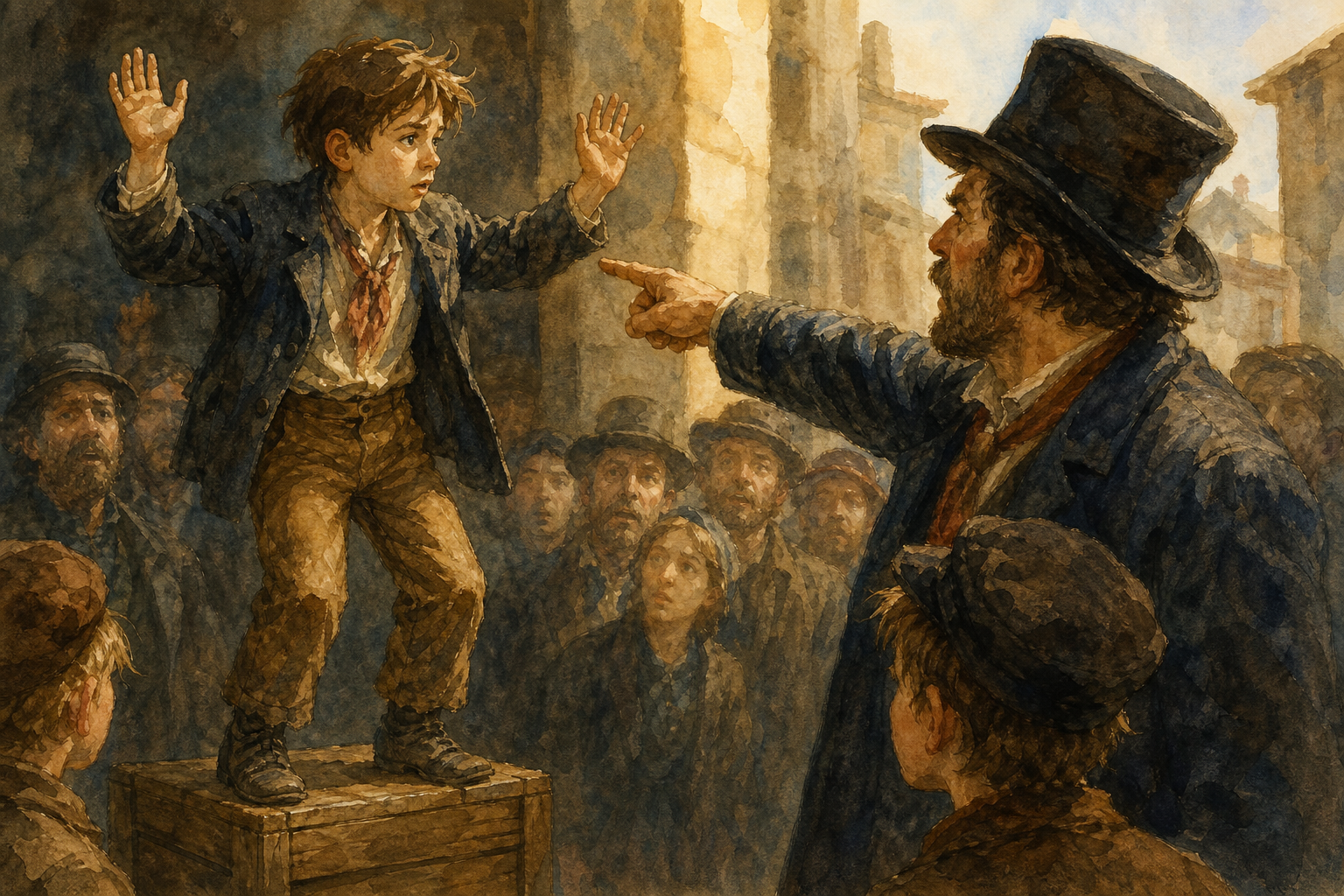
Jacques tried to say the simplest thing: "You cannot distribute meat that does not exist in the city. When we shut meat out, there is less meat. When we shut wood out, there is less wood. When we shut butter out, there is less butter. Everyone gets less. If you want every family to have more, the city must have more. Wealth is quantity, not price tags."
Peter pointed at him. "He is the Norman's man! Paid by foreigners!"
Jacques raised his hands. "I spoke out twenty years ago, when Peter and his friends bent the toll to their advantage. Hang me if you will. Injustice is still injustice. This is not about Jacques against Peter, but about freedom against barriers."
A voice from the crowd suddenly shouted: "Hang no one! Set everyone free!" The rest murmured. The word 'free' hung in the air like a door ajar.
Behind the shouts lay a lesson. Barriers are a little prohibition. Prohibition is a complete barrier. Both are called protection. And they do one thing: they force us to work more to get the same as before. Many cling to protection because freedom at first looks like fewer visible jobs. They forget that work we are spared can be used for other things. If there are two paths to the same pleasure, they choose the one that takes the longest, and wonder why life is heavy.
To show the error clearly, Jacques told an island story. People leaned in. A small boy climbed onto a barrel to hear.
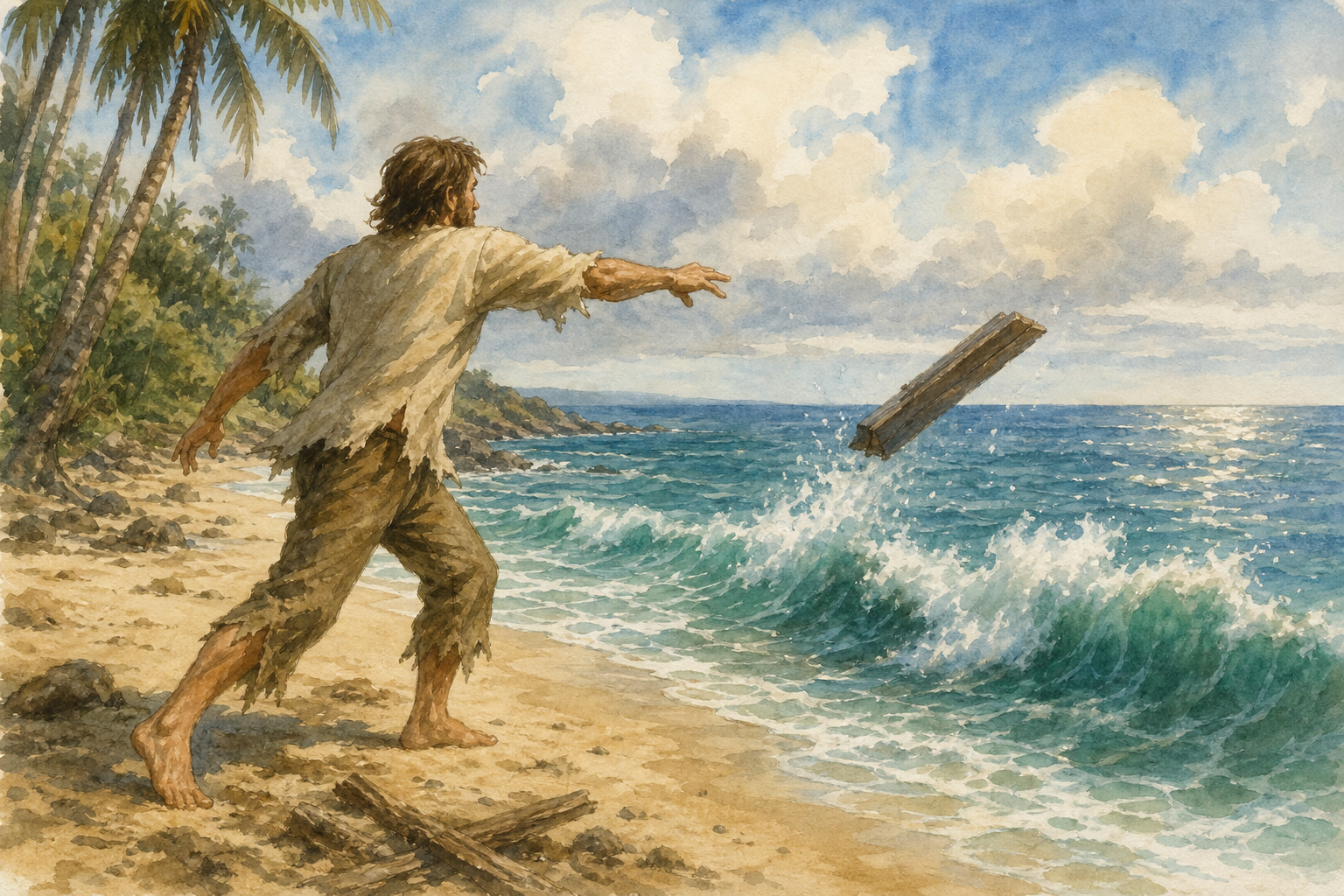
"Imagine an island," said Jacques, "with one man, Robinson. One day the sea washed ashore a beautiful plank. He held it in his hand. He was about to keep it when he thought: If I keep this, I lose fifteen days of work! I could have chopped one myself with my axe. And I would have to spend time sharpening the axe, and finding food while I worked. Work is wealth! I will protect my work against a free gift!" So he threw the plank back into the waves.
People laughed, but felt a sting. Robinson sounded wise – and yet foolish.
"Later," continued Jacques, "a stranger came in a canoe: Friday. He offered four baskets of game every day in exchange for two baskets of vegetables. Friday saw the deal clearly. On the same day they would have as many vegetables as before, more meat – and three hours left over to bathe, sleep, build a hut, learn to sing. Robinson said no. He was afraid. Our hunting trade will be crushed! Those hours will disappear! We will become dependent on a false foreigner! What if one day he grows his own vegetables and drowns us in them, even destroying our garden trade!"
"If he grows his own, we stop trading," replied Friday. "Then we go back to how we were – but we will have had a time of more food and more time. Dependent? To accept the fruit of another's work and give ours is not to put our necks in his hand. It is to bind ourselves together by helping each other." Robinson confused work and purpose. He took the means to be the meaning itself.
Jacques turned to the crowd. "When we divide labor, and when we buy and sell with money, the picture only gets messier, not different. Trade is still exchange, only woven across a whole country. The question is always the same: To get what we need, is it best to make it directly, or to make something else and trade for it?
A law that forbids import forces us to use more hours for fewer goods. If foreign clothes can be obtained by sending off something we make better ourselves, then protection forbids exactly what we are best at, and determines that one day's work shall no longer give two yards of cloth, but only one. Build a fence, and you always get less behind it."
Someone shouted from the back row: "But what if the foreigners do not buy from us in return? What if they only flood us with their goods, and we cannot send anything out?"
Jacques drew a breath. "Common sense and experience answer. If someone wants to give us piles of good things, we must be able to pay. Otherwise the things do not come. We pay with our things – wine, tools, services – or we pay with money. But money is also a thing that must be made, earned, dug, smuggled. For us it is no more mysterious to pay with coins than with coffee or silk. In both cases we have first made something. The mistake everywhere is to measure work by how long and how hard it feels, not by what it gives. So one makes rules that deliberately give worse results, just to keep people tired, and calls this tiredness wealth."
Jacques had several short stories up his sleeve, a little store of images that hit home.
"Food, not the word 'farming,' keeps people alive. If barriers force us to sow on stony ground, just to avoid buying grain from a neighbor, each extra loaf costs more than the last. The most expensive fields determine the price in the end. Dear bread can fill some landowners' pockets, but it makes the people rich and hungry – with big bills in pocket and empty stomachs.
If it were true that everything becomes better for the worker when everything becomes dear, then the cruel months of poor harvest would be golden ages for common folk. They are not. One spring, not long ago, five sixths of the workers received alms. If we are first going to guarantee sellers a good price, we must also guarantee buyers a good wage. Otherwise the law is lopsided."
"It matters less that a nation says: We make iron and cloth, than that it actually has iron and cloth – freely, cheaply, plentifully. Work is not wealth, any more than bleeding is health. Forced labor that is not needed – digging wells by law while forbidding water from the stream – creates toil, not prosperity. The true source of wealth is to obtain pleasures and necessities with as little work as possible. Nature's gifts – sunlight, good meadow, coal beside iron, waterfalls that can turn wheels – spare us effort, and free it for other desires. To hate such gifts is to scold a present and punish generosity."
Some nodded. Others looked hard. A butcher whispered: "What shall I do tomorrow, then?" Jacques heard it. "Jobs do not disappear when doors open," he said. "Jobs move. When we stop using a hundred men to find firewood inside the city, those hundred can make carts, books, shoes, machines – things we have lacked so far."
"Import is paid for with export, or with money – which is also a commodity. Whether we send out coins and get shoes, or send out shoes and get coins, it is the same exchange with different clothes on. We do not measure wealth in kilos of silver, but in how much good we can actually eat, read, warm ourselves with, use.
The state does not need to teach people to eat beef. It only needs to let beef come in. And the state is not a great, wise head over a people of small, foolish heads. If we believe the individual is stupid, then what is the state, other than many such individuals stacked upon each other? Do you want your neighbor to pay your tax for you? That is what a 'compensating tariff' often is. If a tax truly gives us more road, more security, more fairness than it takes, then the producer already has advantages that outweigh it. If not, remove the tax. Do not heap another burden on top, with tariffs. And do not chain money and machines forever to yesterday's mistakes. Capital must be allowed to move with knowledge."
To prick the last remnant of pride, Jacques told a joke. A proposal for a brilliant law: Forbid the right hand! Nods from some, smiles from others.
"Listen," he said, "the government's reasoning is beautiful. The more difficulties, the more work. The more work, the more wealth. Therefore: Create difficulties! Force all trades to be done with the left hand. Workshops will be full. Wages will rise. Coats will require twenty left hands where ten right hands held before. Dearness will be the sign of much work!
And if the Right-Handers' Association asks for freedom, the Left-Handers' Party will answer: Cheap work lowers wages! Abundance makes workers hungry! And besides, doctors say the left side is weaker in the body – a fine reserve of future work! And if more work is needed later, we can use the feet. In the worst case, amputation." Laughter and head-shaking filled the place.
"The joke is serious," said Jacques. "Protection creates obstacles and calls the toil wealth."
"But," shouted an old man from a window seat, "what about the strong countries? They can crush us in peace as surely as in war!"
"Strong in industry means cheap," answered Jacques. "Cheap helps all who buy. It does not kill other people's work, except that it frees some of it from one task and lets it do something else. That is how we have lived with tea and coffee for years. We 'mine' gold and silver by weaving cloth and exchanging it for metal, instead of digging with a spade. Competition saves work and makes us stronger. Protection is like pumping air to someone forced to live under water. Distinguish between work that dies and work that is spared. To have less iron because we have less work is ruin. To have the same amount of iron with less work is gain. Industrial competition is not war. The strongest does not crush the weakest. The strongest lifts the weakest by lowering prices. And if the English flood us with cheap cloth, they must take our goods in exchange. Trade is usage in two directions. Stop talking about invasion and tribute. Such words create hatred. Trade, rightly understood, binds people together."
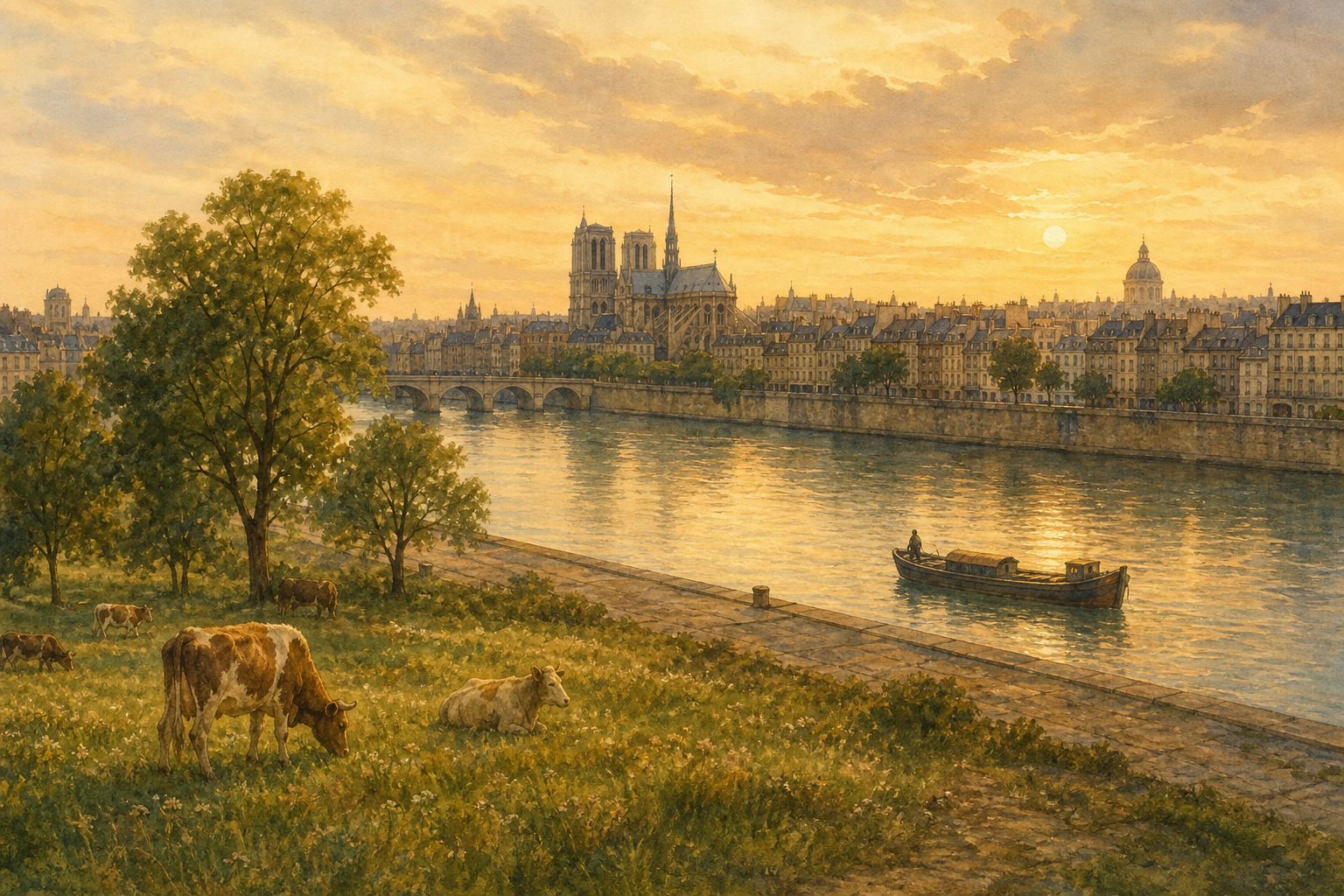
In Paris, where the parable had become reality in a single city, the consequences were visible like shadows on a wall. Under the pretext of work, the poor had first lost the most essential. The most expensive thing of all was not the prices, but that the city's work had been pushed over to poor substitutes that drained the strength from the old trades that had given pride and bread.
The few who grew rich when the privileges came discovered too late how quickly the sea of customers recedes when everyone must pay more for less, and therefore buys little else. The meadow crept all the way to the quay. The city shrank to a big farm.
The father looked at his son and said: "Now we know enough to speak truth to the people. Not shouting, not hanging, not pointing. Just open."
They began small. They went into cow barns that smelled warm and heavy. They greeted men who stood with hands in lukewarm water. "If the gate opens, what then?" asked a young woman, with milk splashed on her sleeve.
"Then butter will become cheaper for you too," said the son. "Your children will get more, without you having to beg for wages. And if one day you want, you can work at something that increases value, not just fight against a gate."
In the wood yard they saw men tying rope around logs that were too short and crooked. "What will you do without us?" asked an elderly lumberman.
"With you," said the father. "Those hands are needed. But perhaps to build bridges, carts, new docks, machines that lift easier. Not to grow a forest in the middle of the city."
In the butcher shop a boy cut thick slices. The meat was dear, and he was afraid of making the customer angry. "Is it true that the pigs from Poitou are dangerous?" he whispered.
"They are just cheaper," said Jacques. "Cheaper meat means your mother can buy a book too, not just bacon. It means the blacksmith can buy shoes for winter. And when the blacksmith buys shoes, the cobbler gets work. When the cobbler gets work, she buys soup from you. That is how the round dance goes."
The boy thought of the book he wanted. He wiped his knife and looked out the door, as if he could see all the way to Poitou.
In the evening they wrote posters. Not fine words. Only clear: "Let the goods come. Let the work find new places. Hang no one. Set everyone free."
The day of the great meeting came. The square was thick with hats, shawls, prams. Peter stood on a wagon and raised his hands. He spoke beautifully about warmth in winter, about jobs that blow away, about the enemy outside who will press us to our knees. The people were with him. Fear is easy to understand.
Then it was Jacques's turn. He did not speak long sentences. He pointed at the people's hands. "Imagine a law that ties your right hand behind your back," he said. "Everything becomes difficult. You use more time for the same thing. You get tired, and you pay more. That is what we do now, only with the gates."
Laughter mixed with unease. A little girl raised her hand. "Why can't we buy from our neighbors, uncle?"
"We can, if the gate does not lock us in," said Jacques. "When the door is open, we can choose."
Finally there was the council again. Fewer quills now, more wrinkles. The father and son stood at the back. They heard both warmth and cold in each representative's speech. An old woman in a headscarf whispered quietly: "Meat for the children. Wood for the night. No more talk."
One of the serious men – he who had always said 'level playing field' – struck the table, but more slowly than before. "We cannot keep making palaces into barns," he said at last. "Let meat, butter, and wood pass. Not by force, but by trust."
For a moment the air was empty. Then, as when a gate opens with a sigh, sounds came from outside: wheels on stone, bells from horses, a shout from a raftsman. The first loads rolled in through the gates. The smell of fresh-cut pine mixed with butter and smoked ham. Prices began to soften, slowly, like ice letting go of the sun.
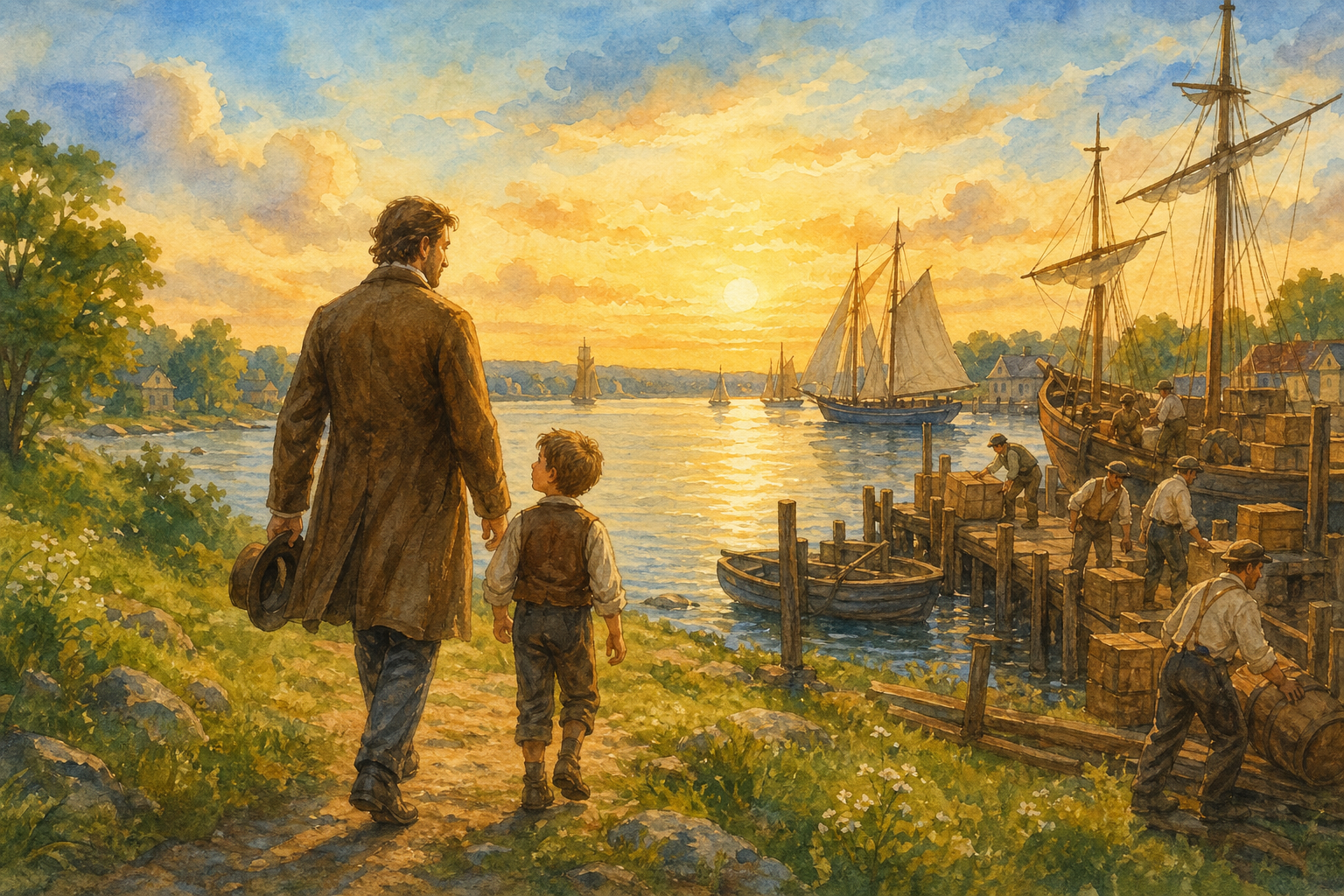
In the next weeks the city changed face. It was not a fairy tale with gold on trees. It was ordinary days – but lighter. Fewer bought bread with a lump in the throat. Some lost their jobs in the yards, but found places in a new hall where clothes were sewn for distant places. An old woodcutter became foreman on a dock that was to reopen. A butcher became a merchant and sold things never before seen in his street.
The father and son walked by the river. The grass was retreating where feet again trampled it down. A sail rose like a white thought. The father's eyes became bright. "From the room to the empty streets, and from the island to the square," he said, "the choice is the same: Shall we admire the toil itself, or love the abundance it can give when we work wisely? Shall we create obstacles and then call it wealth to jump over them? Or shall we accept every ease and every tool that spares our strength and gives us more life?"
He smiled. "We did not need to hang anyone. It was enough to set everyone free."
The son took a deep breath of damp, salty air, and pointed. "Look, boats are coming back." He thought of the graves, of the living, of the children in line at the butcher shop. "When we opened the gates," he said, "we did not let enemies in. We let tomorrow in."